“Where do boutiques get their clothes?” is the question every new boutique owner googles — and the answer is more layered than the vendor lists suggest. There are really three kinds of clothing vendors, they serve different stages of your business, and the boutiques with the best margins usually graduate through all three.
Full disclosure before we start: DenimByte is a private-label clothing manufacturer — the third type on this list. We don't sell wholesale stock, so for the first two categories we have no horse in the race and can be blunt about how they work.
The three types of clothing vendor
1. Wholesale vendors and marketplaces
This is where most boutiques start: buying ready-made styles at wholesale prices and reselling them. The main channels:
- Online wholesale marketplaces — platforms like Faire, FashionGo and OrangeShine aggregate hundreds of brands with buyer protection, net payment terms, and low or no minimums per style.
- Market weeks and showrooms — the LA Fashion District, Dallas Market Center, Magic in Las Vegas and similar let you see fabric and construction in person before committing — which matters more than photos ever will.
- Direct wholesale brands — many labels sell direct to boutiques with line sheets and seasonal pre-orders; you find them at trade shows, on Instagram, and by asking whose pieces sell well in non-competing boutiques.
The trade-off: speed and low risk, but thin margins and zero exclusivity. Retail convention is a roughly 2–2.5× markup on wholesale cost — and the identical garment is usually hanging in other boutiques (and often on cheaper websites), which caps what you can charge.
2. Dropship vendors
The vendor holds the stock and ships to your customer under your store's name. Zero inventory risk, genuinely useful for testing what your audience clicks on — but the thinnest margins of all, no control over shipping speed or packaging, and nothing about the product is yours. Treat it as market research that pays for itself, not a long-term moat.
3. Private-label manufacturers
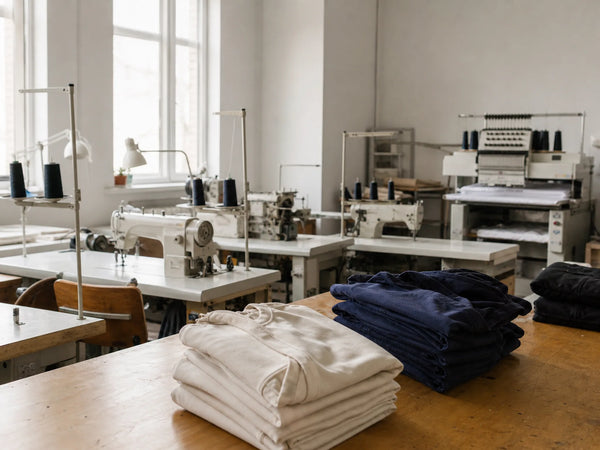
The graduation step: instead of reselling someone else's product, a manufacturer produces garments to your spec — your fit, your fabric, your labels, your packaging. Nobody else stocks it, nobody can price-compare it, and every repeat customer is building your brand's equity rather than a vendor's. (If the terminology is fuzzy, here's the difference between private label and white label.)
The trade-off: longer lead times than buying stock (sampling plus production), more decisions to make, and historically, brutal minimums — though that last barrier has mostly fallen: low-MOQ manufacturers now take small runs, and some (DenimByte included) start from 10 pieces per style.
The margin math boutiques actually care about
Here's the simplified comparison that makes experienced boutique owners move their bestsellers to private label:
- Wholesale: you buy at the vendor's wholesale price — which already includes their brand margin — then apply your ~2–2.5× markup in a market where shoppers can compare prices on the same item.
- Private label: you pay the manufacturing cost directly (here's what actually drives it), and because the product is exclusive to you, your pricing is anchored to your brand's perceived value — not to the cheapest competitor carrying the same SKU. Own-brand products typically support meaningfully higher margins than resold wholesale stock, which is exactly why every major retailer runs private-label lines.
The honest caveat: private label only pays off on styles you already know will sell. Which leads to the playbook.
The playbook: test wholesale, scale private label
- Use wholesale and dropship to learn. Your sales data is telling you which categories, fits and price points your audience actually buys — that data is the cheapest product development you'll ever get.
- Identify your proven repeaters. The hoodie silhouette you've reordered four times, the tee that sells in every colour — those are private-label candidates. One-off trend pieces are not.
- Run a small private-label test. This is where low minimums change the equation: a 10–30 piece run of your bestselling style under your own label risks a fraction of a traditional 300-piece commitment. Sample it first, sell the test run, and read the numbers.
- Scale what works, keep wholesale for variety. Most strong boutiques end up hybrid: an exclusive own-label core delivering the margin, topped up with wholesale pieces for breadth and newness.
Vetting a vendor — whichever type you choose
The full checklist is in our guide to finding and vetting a clothing manufacturer, but the short version applies to wholesale vendors too:
- Order a sample (or a single unit) before any bulk commitment — photos hide fabric weight, stitching and true colour.
- Confirm minimums, reorder availability and lead times in writing.
- Pay through invoiced, trackable channels — never direct transfers to personal accounts, and treat 100% upfront demands from unknown vendors as the red flag it is.
- Check the company is verifiably real: registration, address, consistent contact details. (We're UK company No. SC883537, verifiable on Companies House — every legitimate vendor can offer an equivalent.)
- Judge communication speed and specificity now; it only gets worse after they have your money.
When you're ready for your own label
If your boutique has proven sellers and you're ready to put your own name on them, that's the lane we work in: private-label manufacturing from 10 pieces per style, with a pre-production sample before any bulk commitment and its cost credited when you proceed. Start with our guide for new brands, or send us the style you'd like to test — and vet our answers against the checklist above, exactly as you should with everyone.