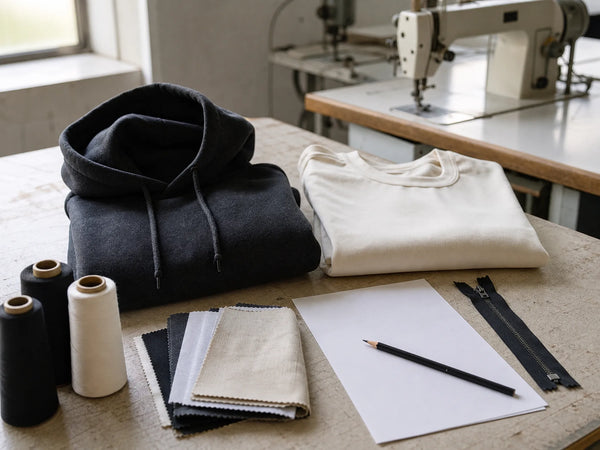
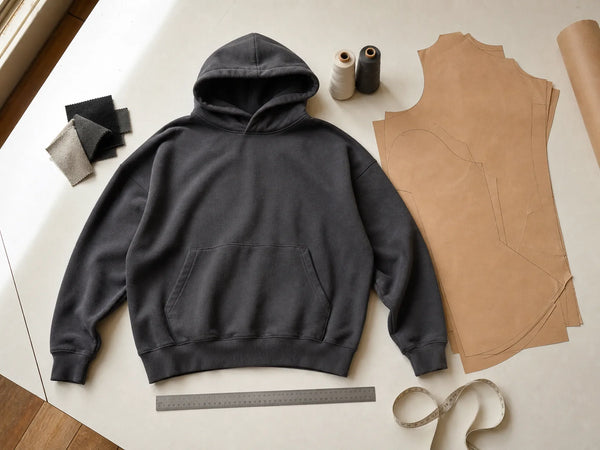
Choosing a manufacturer is the highest-stakes decision your clothing brand will make. Get it right and you have a partner who grows with you for years. Get it wrong and you lose months of runway — or a deposit you never see again.
One thing before we start: DenimByte is a clothing manufacturer, so we are not a neutral party in this guide. But that is exactly why it is useful — we know the questions a good factory answers happily and a bad one dodges. Use everything below on every manufacturer you shortlist, including us.
Step 1: Know what you need before you search
Most bad manufacturer relationships start with a vague brief. Before you contact anyone, write down:
- Product and construction — "hoodies" is not a spec. 450 GSM heavyweight fleece pullover with double-lined hood is. (If fabric weights are new to you, start with our GSM guide.)
- Realistic quantities — standard factories often want 300–1,000+ units per style. Low-MOQ manufacturers typically accept somewhere between 25 and 150. A small number — DenimByte included — will start from 10 pieces per style. Know which tier you are shopping in, because it decides who will even reply. (More on this in our MOQ guide.)
- Fully custom or customised blanks — decorating existing garments is faster and cheaper than cut-and-sew manufacturing from fabric rolls. Decide which route fits your first drop.
- Budget and deadline — including shipping and duties, not just the unit price. Our cost breakdown covers what actually drives the number.
You do not need a full tech pack to get quotes — good manufacturers will work from reference images and measurements — but if you have one, it speeds everything up. Here is what a tech pack is and when it matters.
Step 2: Decide where your manufacturer should be
The honest version of the domestic-vs-overseas debate:
- Domestic (your own country) — easiest communication and site visits, shortest shipping, and usually the highest unit costs and higher MOQs than you would expect. Capacity for small brands is limited in the UK and US.
- Overseas (Asia, North Africa, Eastern Europe) — significantly lower unit costs and deep garment expertise, but time zones, language gaps, longer shipping, and harder accountability when something goes wrong.
- The hybrid model — a local-to-you sales and support team managing overseas production. You get local-hours communication and one accountable point of contact, with factory-level pricing. This is how DenimByte works: a UK team in Dundee coordinating our production facility, so a UK, EU or US brand never waits overnight for an answer.
None of these is "correct". What matters is that the manufacturer is upfront about where production actually happens — if that is hard to find out, walk away.
Step 3: Where to actually look
- Search with buyer-grade queries — not "clothing manufacturer" but "low MOQ hoodie manufacturer", "cut and sew manufacturer for streetwear", "private label tracksuit manufacturer". Specific queries surface specialists.
- Sourcing directories — Maker's Row (US), Sewport, Kompass and similar platforms list vetted factories with capability filters.
- Trade shows — events like Magic (Las Vegas) and Pure London put you in front of dozens of factories in a day.
- Ask brands you admire — founders are often surprisingly open about their supply chain, especially if you are not a direct competitor.
- Marketplace platforms — Alibaba and similar give enormous choice, but you are doing all the vetting yourself, so the checklist below matters double there.
Step 4: The ten questions that separate real factories from middlemen
Send these to every shortlisted manufacturer. The pattern of answers tells you more than any website:
- What is your MOQ per style and per colour? A vague answer, or an MOQ that jumps after sampling, is a warning sign.
- Can I order a pre-production sample first, and what does it cost? Any factory that resists sampling is asking you to gamble. Ask whether the sample cost is credited against your bulk order — the good ones say yes.
- What are your sampling and production lead times? Typical honest answers: 1–3 weeks for a sample, 3–6 weeks for bulk production after approval. Anyone promising dramatically faster with no conditions is usually promising what they cannot deliver.
- Is your quote all-in? Unit price alone means little. Ask what happens with decoration, labels, packaging, and delivery — an all-in landed figure is the only number you can actually budget on.
- What are your payment terms — and how are payments made? A deposit of 30–50% with the balance before shipment is industry standard (we work on 40/60). Just as important: payments should run through invoiced, trackable channels — card, PayPal, or a platform checkout. Treat "full payment upfront" or "direct bank transfer only" as serious red flags. Our payment terms page shows what transparent looks like.
- Are you a factory or an agent? Agents can be useful, but you should know if there is a margin-taking layer between you and production — and who is accountable for defects.
- How do you handle quality control? Listen for inspection at multiple stages of production, not just a final check before boxing.
- What happens if the bulk order does not match the approved sample? The answer should be specific: rework, replacement, or refund — not "that never happens".
- Can I verify who you are? A registered company number, a real address, and consistent contact details take two minutes to check and filter out most scams. (DenimByte is UK company No. SC883537 — verifiable on Companies House.)
- How fast do you communicate? Reply speed and answer quality during the quoting stage is the best predictor of what production will feel like. Slow, thin answers now become silence when there is a problem later.
The red flags that predict disaster
- 100% payment upfront — the single most consistent scam signal in this industry.
- Untraceable payment methods only — direct transfers to personal accounts, crypto, or "payment links" outside any invoicing system.
- No samples, or pressure to skip sampling — no legitimate factory fears its own output.
- Prices dramatically below everyone else — you will pay the difference in fabric quality, missed deadlines, or a vanished deposit.
- Vague or shifting MOQs — quoted low to hook you, raised once you are invested.
- Certification claims with no documents — anyone can type "certified"; ask for the certificate number and issuer.
- No verifiable company behind the website — no registration, no address, stock photos of someone else's factory.
Step 5: Always sample before bulk
A sample is not an optional extra — it is the entire risk-control mechanism of custom manufacturing. It proves fabric, fit, stitching, and decoration on a real garment before you commit real money, and it becomes the quality reference the bulk order is judged against. Here is what the sampling process looks like step by step, and how sampling works at DenimByte — 7–14 days, with the cost credited against your bulk order.
Step 6: Start small, then scale
Your first production run is also your last test of the manufacturer. Keep it as small as their MOQ allows, sell it, learn from it, and scale the reorder. This is precisely why low minimums matter for new brands — a 10-piece first run risks a fraction of what a 300-piece commitment does, and a manufacturer who supports small runs is signalling they want to grow with you rather than extract from you. (If you are at the very start of this journey, our guide to starting a clothing brand covers the full path.)
The 60-second shortlist checklist
- MOQ confirmed in writing, per style and colour
- Sample offered, priced, and credited against bulk
- All-in quote covering decoration, labels, packaging and delivery
- Deposit-based payment through invoiced, trackable channels
- Factory-or-agent status and production location stated plainly
- QC at multiple stages, with a specific defect policy
- Verifiable registered company
- Fast, specific communication from the first message
Whoever you end up manufacturing with, hold them to this list. And if you want to see how we answer these questions ourselves, our process, pricing, and startup guide pages lay it out — or just send us your project and judge our answers against everything you have just read. That is what this guide is for.