Let's be honest about the headline first: you cannot build a clothing brand with literally zero money forever. What you can do — and what the smartest founders actually do — is start at £0, prove demand before spending, and only put money into products you already know will sell. Industry guides consistently put a realistic first-launch budget at a few hundred to a thousand pounds; the ladder below is how you climb to that point without wasting any of it.
This is the budget companion to our full step-by-step guide to starting a clothing brand — that one covers the whole journey, this one covers the money.
Stage 0: Validate for free (spend: £0)
Before any product exists, you can test whether anyone wants it:
- Build the audience before the product. Post the designs, the moodboard, the story. If you can't get strangers to follow an idea, inventory won't fix that.
- Mock it up. Free mockup tools put your design on a photorealistic hoodie or tee in minutes — enough to gauge real reactions.
- Count the signal. DMs asking "where can I buy this?" are the only validation metric that matters. Screenshots of compliments are not.
Stage 1: Print-on-demand — zero upfront, thin margins (spend: £0)
Print-on-demand (POD) platforms print your design on a stock garment when a customer orders, and ship it directly. No inventory, no upfront cost, no risk.
The honest trade-offs: per-unit costs are high so margins are thin, the base garments are generic, you can't control fabric, fit, packaging — or what the label says. POD is not a brand; it's a paid market test. Its real output isn't profit — it's data on which designs strangers will pay for. Take that data and move up the ladder.
Stage 2: Customised blanks — the sweet spot for small budgets
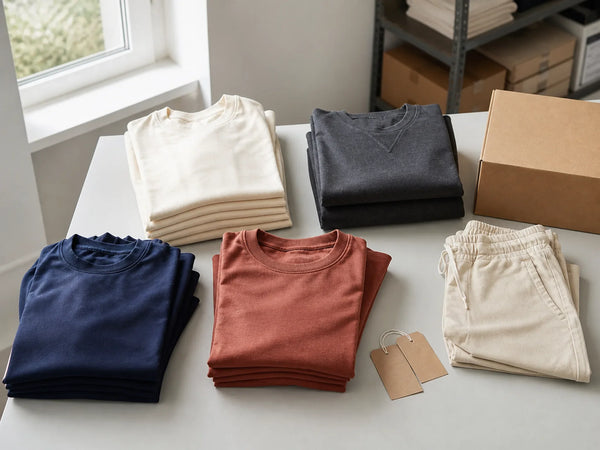
The step most founders should take first with real (but small) money: buy quality blank garments and have them professionally decorated with your designs — printing, embroidery, and crucially relabelling with your own brand labels. Compared to POD you get better garments, meaningfully better margins, and something that finally looks and feels like a brand when it's unboxed.
Compared to full custom manufacturing, it's faster and cheaper because the garment already exists — you're customising, not constructing. This is a real service route at DenimByte alongside fully custom production, and for first drops it's usually the right call. Our guide to ordering small runs without sacrificing quality applies directly here.
Stage 3: Pre-orders — let customers finance production
The bootstrapper's best trick: sell first, produce second.
- Photograph one professionally-made sample of your design — one garment, not a production run.
- Open pre-orders for a limited window, framed honestly as a drop: "ships in 4–6 weeks."
- Use the pre-order revenue to fund the production run — which you now know sells, in the exact sizes people ordered.
Limited drops with shipping windows are standard practice in streetwear — scarcity is a feature, not an apology. The one rule: never take pre-order money without a confirmed production plan and timeline behind it.
Stage 4: Small-batch custom manufacturing (from 10 pieces)
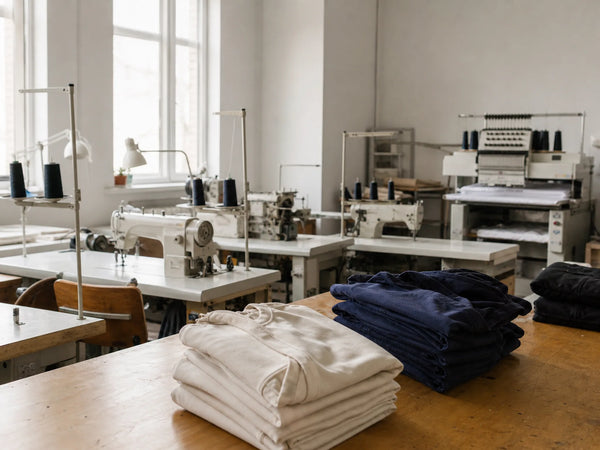
When a design has proven itself — through POD data, a blanks drop, or pre-orders — it earns real manufacturing: your fabric weight, your fit, your construction, fully yours. The barrier here used to be minimums of 300+ units; low-MOQ manufacturers have collapsed that, and at DenimByte a run starts at 10 pieces per style, with a pre-production sample first whose cost is credited against the bulk order. (Here's what actually drives the cost of that run — and how to keep it down.)
Ten pieces of a proven design, sold at own-brand margins, then reordered bigger: that's the compounding loop every bootstrap brand runs.
Where the little money you have should go
- Spend on: one great sample, professional photos of it (a phone plus daylight genuinely works), your labels, and — above all — product quality. A garment that feels premium gets reordered and word-of-mouths for free.
- Don't spend on: logo redesigns, paid ads before you have proof of demand, trademark filings on day one, or 300 units of anything unproven.
The realistic timeline
- Weeks 1–4: audience + mockups + validation (£0)
- Weeks 4–8: POD test of 3–5 designs (£0 upfront)
- Weeks 8–16: first blanks drop or pre-order campaign on the winners (first real spend)
- Month 4+: first small-batch custom run of the proven bestseller, funded partly by earlier sales
Every stage is funded by the one before it. That's what "starting with no money" actually looks like — not zero spend, but zero wasted spend.
When you're ready for a manufacturer
At stages 2–4 you'll need a production partner — vet them properly using our guide to finding a clothing manufacturer (use it on us too). Our startup manufacturing page covers exactly how we work with first-time founders, and quotes are free with no obligation — tell us what you're building, whether that's decorated blanks for a first drop or a 10-piece custom run of the design your audience already voted for.